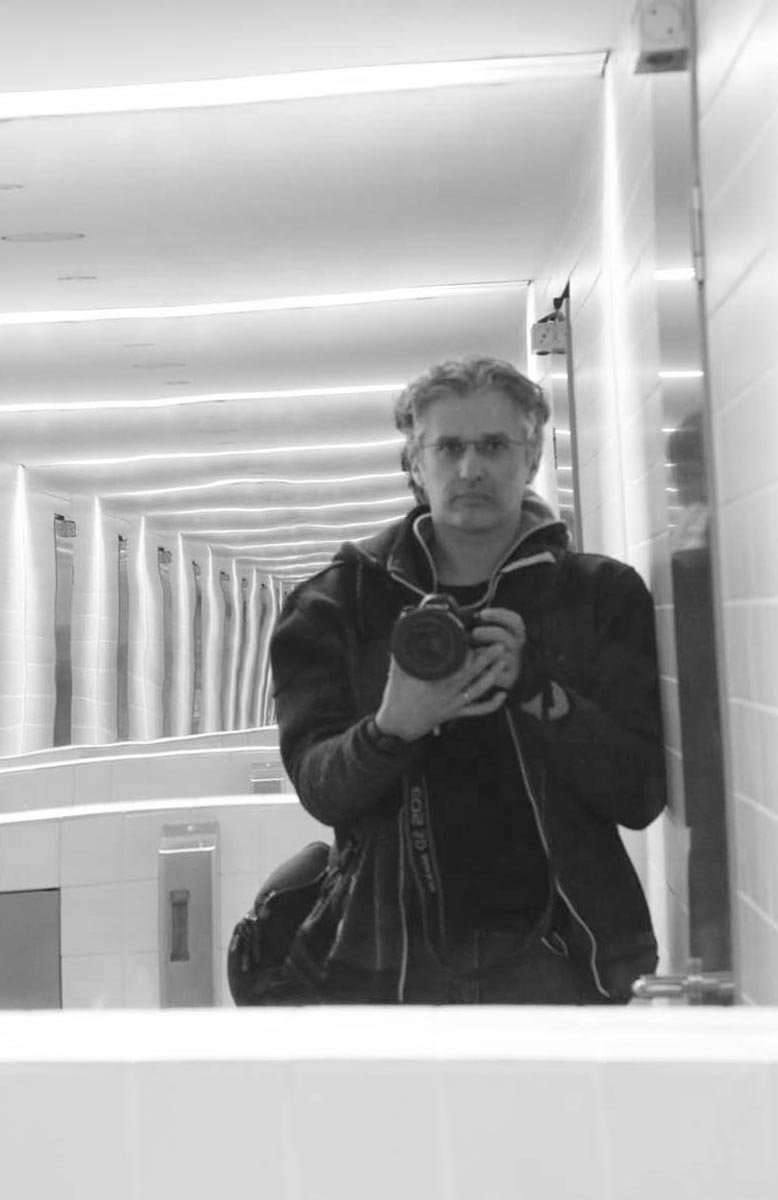
Perspective has a bad reputation.
When someone says that something is ‘a matter of perspective’, they usually mean that it can be seen one way or another. Everyone has their own point of view. You have yours, I have mine, and somewhere in between lies the truth.
That is convenient. And it plays down what perspective actually means.
Because a perspective is not simply an opinion.
It is, first of all, a position.
I cannot see without being somewhere. What lies in front of me obscures something else. What is close appears large; what is far away appears small. I see the front, not the back. If I move, the image changes. The objects themselves do not have to change at all.
This is so self-evident that we easily overlook its consequences:
Every act of perception begins with a limitation.
In order to see something, I must not see something else.
Perspective is therefore not merely one way of seeing. It is the condition that makes seeing possible.
The Trick with the Window
In the history of art, this idea takes on a particular significance.
The central perspective of the Renaissance seems so natural to us today that we easily mistake it for a faithful representation of reality. A picture opens like a window. Lines converge towards vanishing points. Objects become smaller as their distance increases. Space appears to continue behind the picture plane.
It looks right.
But ‘looks right’ is a remarkable phrase.
Perspective is, after all, a construction. It organises the visible world from a particular position. That position belongs to a viewer.
Erwin Panofsky therefore described perspective as a ‘symbolic form’. The crucial question is no longer simply whether a representation is perspectivally correct. What becomes interesting is the conception of the world expressed through a particular form of representation.
That changes everything.
Perspective does not simply depict reality.
It orders it.
The Invisible Centre
Classical central perspective has a remarkable protagonist who does not even have to appear in the picture:
the viewer.
The construction is aligned with them. From their imagined position, the space makes sense. They are, in a way, the invisible centre of the picture.
We humans probably rather like that.
We see the world and take what we see to be the world.
In doing so, we are remarkably quick to forget the person who is looking at it.
Ourselves.
I see a space and say: This is what it looks like.
I see a person and say: This is what they are like.
I see an image and say: This is what it means.
I see a situation and say: This is how it was.
Yet each of these statements should be preceded by a qualification:
From here.
From my position. With my experience. With my knowledge. With my expectations. At this moment. Under these conditions.
This does not make perception arbitrary.
But it does make it conditional.
The Blind Spot of Every Perspective
The most interesting thing about a perspective may therefore not be what it shows.
But what it inevitably conceals.
Every perspective creates a blind spot.
Someone standing in front of a house sees its façade, not its rear. Someone reading a message knows its wording, but not necessarily the intention behind it. Someone looking at a photograph sees what lies within the frame—and nothing of what happened a second earlier, a second later or a metre to one side.
And yet we complete what is missing.
We are remarkably good at it.
Perception provides fragments; our thinking constructs connections from them. We add, compare, remember, anticipate and interpret. Incomplete information gives rise to a world that appears remarkably complete to us.
That is an extraordinary achievement.
And a problem.
Because what appears plausible does not have to be true.
Perception creates plausibility, but not truth.
The Eye Is Not a Neutral Witness
This applies particularly to photography.
For a long time, the camera carried with it the promise of being a more neutral observer than the human being. Light falls through a lens onto film or a sensor. Something was there in front of the camera and left a trace.
But a camera also has a position.
Someone puts it there.
Someone chooses the frame.
Someone decides on the focal length, the moment, the exposure and the distance.
And even if no one makes these decisions consciously, they do not disappear.
The photograph therefore does not simply say:
That was there.